Home / Courses
Courses we offer
Five mentor-led programs that take you from your first DGCA subject to your type-rated airline seat - each built around how airlines actually train, assess, and operate.
Five mentor-led programs that take you from your first DGCA subject to your type-rated airline seat - each built around how airlines actually train, assess, and operate.
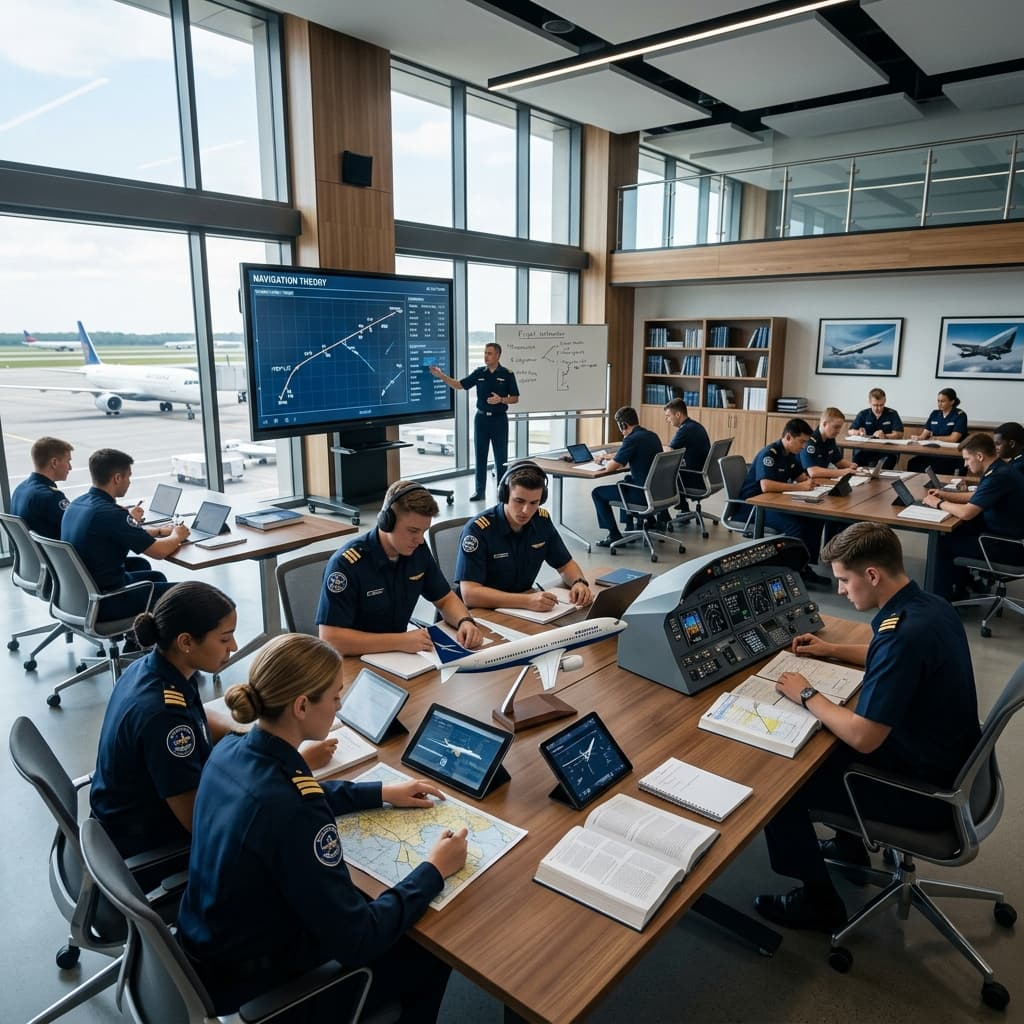
Master all six DGCA subjects with conceptual clarity. Our mentor-led ground school replaces rote learning with deep understanding for first-attempt success.
Meteorology is the science of weather. It is essentially an inter-disciplinary science because the atmosphere, land and ocean constitute an integrated system. The three basic aspects of meteorology are observation, understanding and prediction of weather. Aviation Meteorology is one of the most important subjects in pilot training, helping students understand how weather affects flight operations and safety. This subject covers the atmosphere, pressure systems, winds, clouds, fog, thunderstorms, turbulence, icing, and other weather phenomena. Students learn how to interpret aviation weather reports, forecasts, METARs, TAFs, and weather charts used in daily flight planning. A strong understanding of meteorology enables pilots to make informed decisions, avoid hazardous weather conditions, and ensure safe and efficient flight operations. At Central India Pilot Training Academy, our expert instructors simplify complex weather concepts through practical examples and DGCA-focused training, helping students build confidence for examinations and real-world flying.
Air regulations dictate the legal framework, safety protocols, and operational standards of civil aviation. They are governed globally by the International Civil Aviation Organization (ICAO) and nationally enforced by agencies like the Directorate General of Civil Aviation (DGCA) in India. Air Regulations is a vital subject in pilot training that provides students with a thorough understanding of the rules, procedures, and legal requirements governing civil aviation. The subject covers international aviation standards, ICAO regulations, DGCA rules, air traffic services, airspace classification, rules of the air, flight operations, licensing requirements, and aviation safety procedures. Students learn how regulations ensure safe, orderly, and efficient aircraft operations while maintaining compliance with national and international aviation laws. A strong knowledge of Air Regulations enables pilots to make correct operational decisions, communicate effectively with air traffic control, and uphold the highest standards of aviation safety and professionalism. At Central India Pilot Training Academy (CIPTA), our DGCA-focused training helps students master regulatory concepts and build confidence for both examinations and real-world flying operations.
Technical General is a core subject in pilot training that provides students with a comprehensive understanding of aircraft systems, aerodynamics, engines, and flight mechanics. The subject covers the principles of flight, aircraft structures, piston and turbine engines, fuel systems, electrical systems, hydraulic systems, flight controls, landing gear, and aircraft instruments. Students learn how various aircraft components function together to ensure safe and efficient flight operations. Technical Specific is an advanced aviation subject that focuses on the detailed study of a particular aircraft type and its systems, providing in-depth knowledge of aircraft performance, limitations, operating procedures, powerplant systems, avionics, and emergency management. Students learn how each aircraft system operates and how to manage normal and abnormal situations safely and efficiently. At Central India Pilot Training Academy (CIPTA), our DGCA-focused Technical training combines theoretical knowledge with practical aircraft system understanding, enabling students to excel in examinations and develop a deeper understanding of modern aircraft operations.
RTR(A) is an important aviation communication subject required for pilots to operate aircraft safely and effectively. It covers the use of radio communication between pilots and Air Traffic Control (ATC), standard aviation phraseology, communication procedures, and handling of normal and emergency situations. Students learn ATC instructions, clearances, position reporting, distress and urgency messages, and correct radio discipline as per aviation standards. RTR(A) training helps pilots develop confidence and accuracy in cockpit communication. At Central India Pilot Training Academy (CIPTA), we provide focused RTR(A) preparation with practical communication practice, mock sessions, and exam-oriented guidance to help students achieve success and become professional pilots.